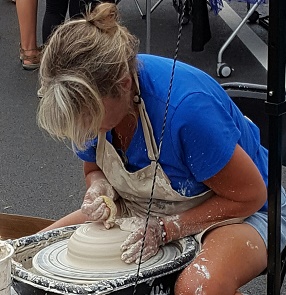
Wheel Throwing Fundamentals
Learn how to center clay, pull walls, and shape vessels on the potter's wheel. A step-by-step guide for beginners and improvers.
From hand-building to wheel throwing, from raw earth to glazed masterpiece — explore the living craft of pottery rooted in Czech soil.
Whether you are picking up clay for the first time or refining advanced techniques, our guides walk you through every stage of the ceramic process.
Learn how to center clay, pull walls, and shape vessels on the potter's wheel. A step-by-step guide for beginners and improvers.

Understand glaze chemistry basics, application methods, and decorative techniques that bring ceramic surfaces to life.

Master the two-stage firing process. Learn temperature schedules, kiln types, and how to avoid common firing defects.

In an age of mass production, working with clay offers something increasingly rare: direct contact with a material that responds to every gesture. Pottery is not just a hobby — it is a meditative practice that connects modern makers with thousands of years of human craftsmanship.
Studies from the Arts Council England suggest that craft engagement reduces stress and improves focus. The tactile nature of clay — its coolness, weight, and plasticity — engages the senses in ways that screen-based activities simply cannot.
The Czech Republic holds a long ceramic lineage, from medieval stove tiles produced in South Bohemian workshops to the industrial porcelain of Karlovy Vary. Towns like Bechyne and Tepla have been centers of ceramic production for centuries, developing distinctive regional glazes and firing methods.
Today, Czech ceramicists blend this heritage with contemporary aesthetics. Annual events like the Bechyne Ceramics Symposium draw makers from across Europe, reinforcing the country's status as a living center for the clay arts.
Explore Czech Heritage
A few things worth knowing before you dig your hands into clay.
Earthenware fires at 1000-1150 C and remains porous without glaze. Stoneware, fired at 1200-1300 C, becomes vitreous and watertight — the workhorse of functional pottery.
Before throwing, clay must be wedged (kneaded) to remove air pockets. Trapped air expands during firing and can cause pieces to crack or explode in the kiln.
The first firing (bisque) transforms fragile dried clay into a durable, porous state that readily absorbs glaze. Typical bisque temperature: cone 06 (around 998 C).
Deepen your knowledge with trusted external sources on ceramics and pottery.